Why Some Players Shine in Training but Struggle in Matches
Understanding the hidden gap between practice performance and match performance—and how to close it.
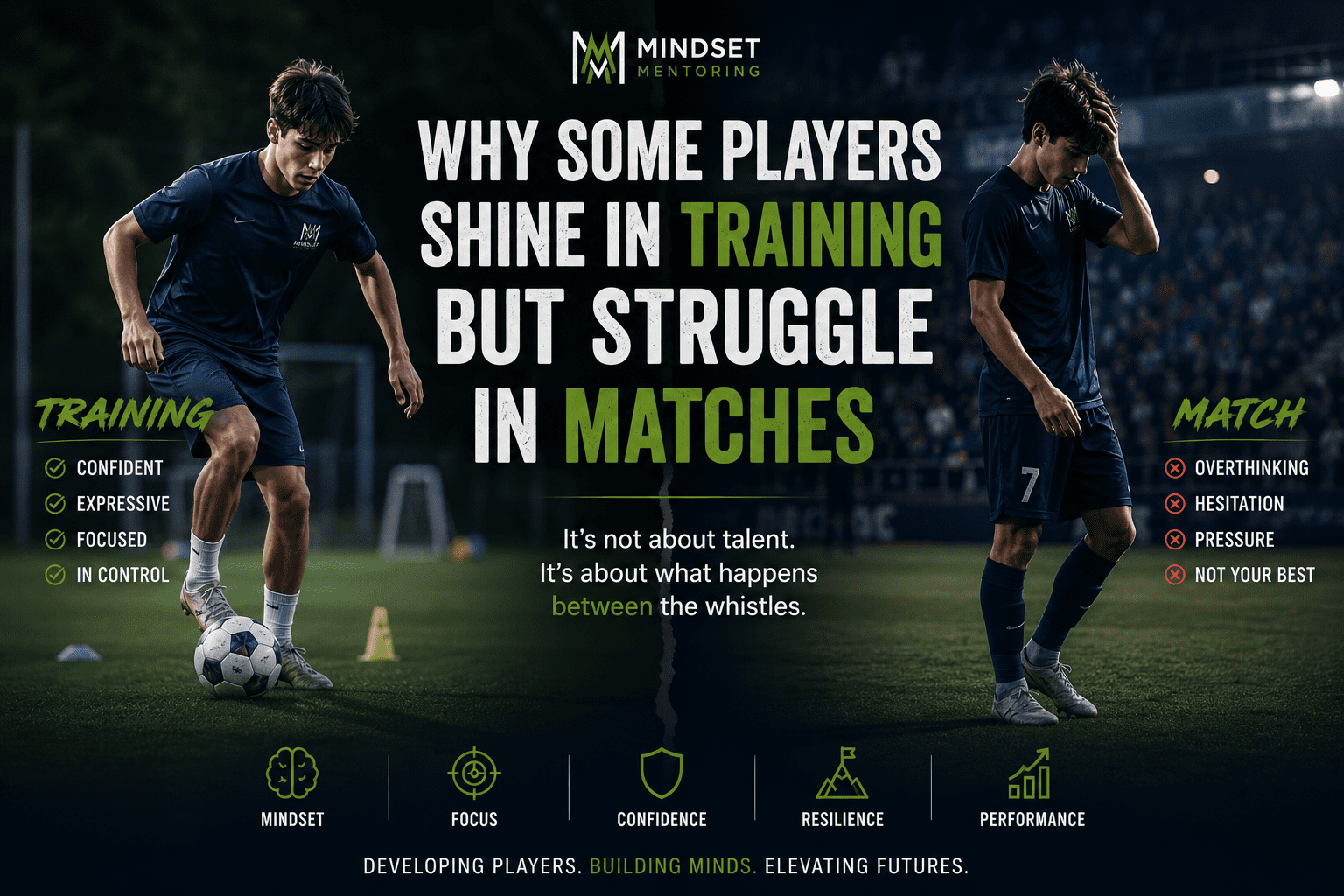
Have You Ever Asked Yourself This Question?
You train brilliantly all week.
Your first touch is sharp. Your passing is clean. You dominate small-sided games. Coaches praise your effort. Teammates notice your quality.
Then match day arrives.
Suddenly:
❌ Your decisions feel slower.
❌ You play safer than usual.
❌ You hesitate in moments where you normally act instinctively.
❌ You worry about making mistakes.
❌ You leave the pitch feeling frustrated because you know you’re capable of more.
Sound familiar?
If so, you’re not alone.
One of the most common challenges in player development is the gap between training performance and match performance. Many talented players show their best version during the week but struggle to transfer that level into competitive games.
The good news?
This problem is not usually about talent.
It’s usually about mindset, pressure management, confidence, focus, and preparation.
And those are skills that can be trained.
The Truth: Soccer Matches Are Different
Training and competition may look similar on the surface.
But psychologically, they are completely different environments.
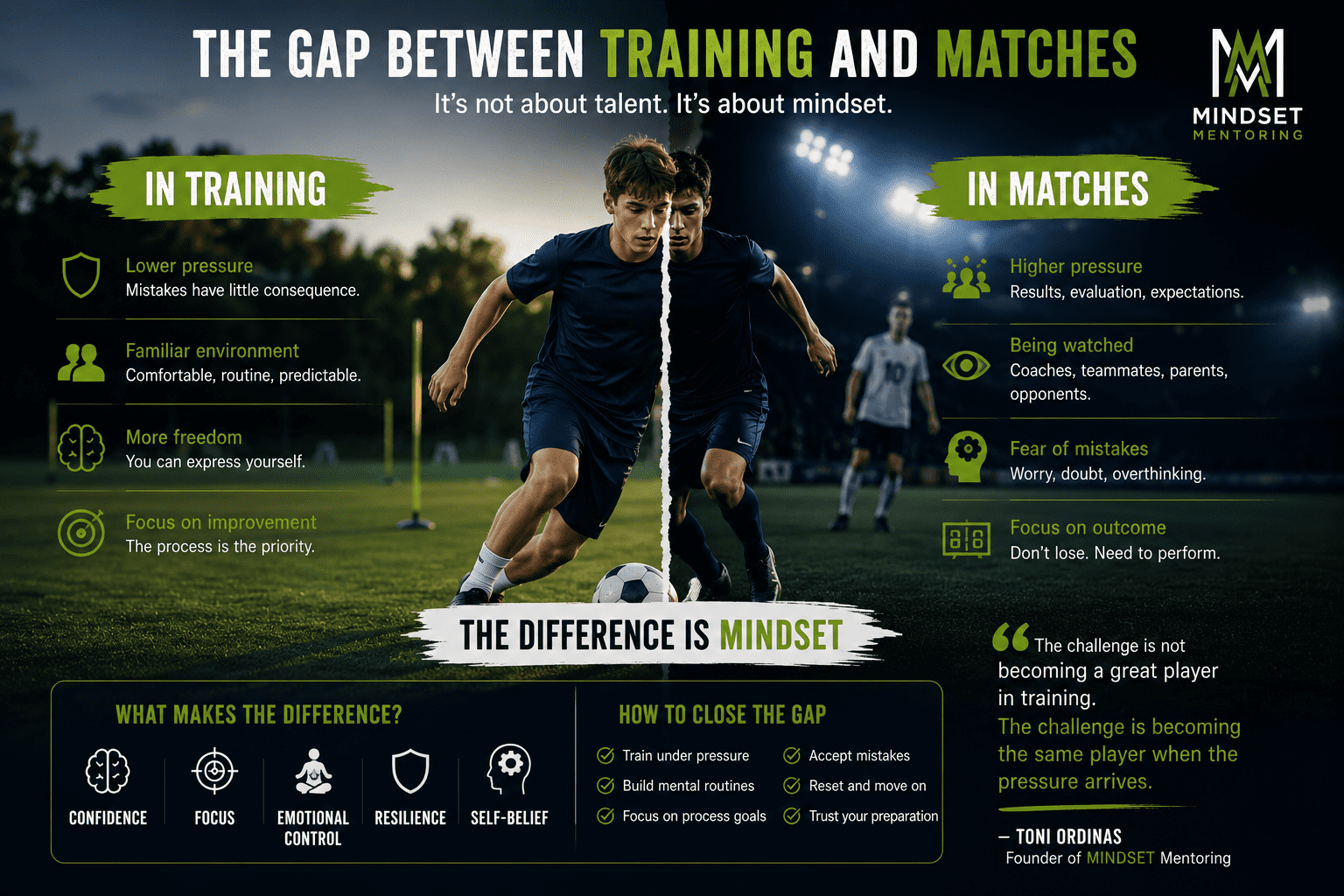
During training:
✅ Mistakes have fewer consequences.
✅ The emotional intensity is lower.
✅ There is less fear of judgment.
✅ Players often feel more relaxed.
✅ The outcome is less important.
During matches:
🔥 Selection decisions are on the line.
🔥 Parents are watching.
🔥 Coaches are evaluating.
🔥 Teammates depend on you.
🔥 The result matters.
🔥 Expectations increase.
This creates pressure.
And pressure reveals habits.
As we teach in the MINDSET Mentoring methodology, pressure does not create a player—it reveals the player’s preparation, mindset, and mental habits.
The challenge is not becoming a great player in training. The challenge is becoming the same player when the pressure arrives.
Antoni Ordinas - Founder of MINDSET Mentoring
The Fear of Making Mistakes
One of the biggest reasons players struggle in matches is simple:
They become afraid of making mistakes.
Instead of focusing on what they want to do, they focus on what they want to avoid.
Their internal dialogue sounds like:
💭 “Don’t lose the ball.”
💭 “Don’t make another mistake.”
💭 “Coach is watching.”
💭 “I need to play well.”
The problem?
Your brain focuses on whatever receives attention.
When your attention moves toward fear, your game becomes cautious.
You stop expressing your real qualities.
You play not to fail instead of playing to succeed.
Elite players understand something different:
They accept mistakes as part of the game.
They focus on execution, not perfection.
As we explain in the course, consistency is not perfection. It is the ability to maintain your standards and commitment even when mistakes happen.
Why Confidence Changes on Match Day
Many players believe confidence is something they either have or don’t have.
That’s not true.
Confidence is heavily influenced by context.
In training:
✔ Familiar environment.
✔ Familiar teammates.
✔ Lower emotional risk.
✔ More freedom to experiment.
In matches:
✔ Greater uncertainty.
✔ More pressure.
✔ More emotional consequences.
If your confidence depends on everything going well, it will disappear quickly when pressure rises.
Real confidence comes from something deeper.
It comes from preparation.
It comes from self-belief.
It comes from knowing:
“Even if I make mistakes, I can still compete.”
The best players don’t enter matches expecting perfection.
They enter matches trusting their preparation.
Many players train their skills every day. Few train their response to pressure. That is often the difference between potential and performance.
Antoni Ordinas - Founder of MINDSET Mentoring
The Hidden Enemy: Overthinking
Soccer is a fast game.
The best decisions happen almost instinctively.
But pressure often creates overthinking.
Instead of:
⚽ Receiving → deciding → executing
The player starts:
⚽ Receiving → analyzing → doubting → hesitating → executing
Those extra seconds change everything.
Suddenly:
❌ The pass arrives late.
❌ The first touch becomes heavy.
❌ The opportunity disappears.
Research in sports psychology consistently shows that excessive conscious control during performance can interfere with automatic skills that have already been learned through training.
In simple terms:
The player starts thinking about playing instead of simply playing.
Why Elite Players Stay Calm Under Pressure
Watch players like:
Lionel Messi
Kevin De Bruyne
Aitana Bonmatí
Virgil van Dijk
One thing stands out.
They rarely look rushed.
They rarely appear emotionally overwhelmed.
Why?
Because elite players learn to focus on the controllables.
Not:
❌ The crowd.
❌ The score.
❌ The coach’s opinion.
❌ The previous mistake.
Instead:
✅ The next action.
✅ The next duel.
✅ The next pass.
✅ The next defensive action.
This present-moment focus allows talent to emerge naturally.
As discussed throughout the MINDSET Mentoring curriculum, elite performers learn to control attention rather than allowing emotions to control attention.

The Match Performance Formula
At MINDSET Mentoring, we often describe performance using a simple principle:
Talent × Consistency × Mindset
Talent gives you the ability.
Consistency allows you to repeat it.
Mindset allows you to access it under pressure.
Many players focus heavily on improving talent.
Far fewer train consistency.
Even fewer train mindset.
Yet mindset is often the factor that determines whether your training level appears on match day.
Pressure does not reduce your talent. It reveals how much you trust it.
Antoni Ordinas - Founder of MINDSET Mentoring
Five Practical Ways to Perform Better in Matches
1. Focus on Process Goals
Instead of:
❌ Score a goal.
❌ Get an assist.
Try:
✅ Win my first duel.
✅ Scan before receiving.
✅ Communicate constantly.
✅ Sprint after every transition.
Process goals create control.
Results do not.
2. Create a Pre-Match Mental Routine
Elite players rarely enter matches mentally unprepared.
Build a routine including:
✅ Controlled breathing.
✅ Positive self-talk.
✅ Visualization.
✅ Clear intentions.
The goal is simple:
Arrive mentally ready before the first whistle.
3. Expect Mistakes
This may sound strange.
But expecting mistakes actually reduces pressure.
Every player makes them.
The question is not:
“Will I make one?”
The question is:
“How fast will I recover?”
4. Develop a Reset Routine
After a mistake:
➡️ Deep breath.
➡️ Positive cue.
➡️ Focus on the next action.
Many elite players use simple mental anchors such as:
“Next play.”
“Reset.”
“Stay present.”
Your ability to recover quickly is often more important than avoiding mistakes altogether.
5. Train Under Pressure
Pressure management cannot be learned only through reading.
It must be practiced.
Create training environments that include:
🔥 Competition.
🔥 Consequences.
🔥 Time pressure.
🔥 Decision-making under fatigue.
The more pressure you experience in training, the more familiar it feels in matches.
Final Thoughts
If you’re a player who shines in training but struggles in matches, don’t assume you lack talent.
In many cases, your match performance is not limited by technical ability.
It’s limited by:
Fear of mistakes.
Overthinking.
Pressure.
Confidence instability.
Lack of mental preparation.
The encouraging part?
All of these can be improved.
The best players aren’t necessarily those with the most talent.
They’re often the players who can access their talent when pressure is highest.
Because in elite soccer, everyone has ability.
The difference is who can bring it to life when it matters most.
Final Reflection
Ask yourself:
💭 What changes in my thoughts before a match?
💭 What am I afraid of losing?
💭 What would happen if I focused only on the next action?
💭 Am I trying to be perfect—or trying to compete?
Your answers may reveal the biggest opportunity for growth in your game.