Feedback That Improves Performance:
What Great Coaches Do Differently
How elite coaches use feedback to build confidence, accelerate learning, and improve performance without creating fear or dependency.
Scenario:
A player makes a mistake.
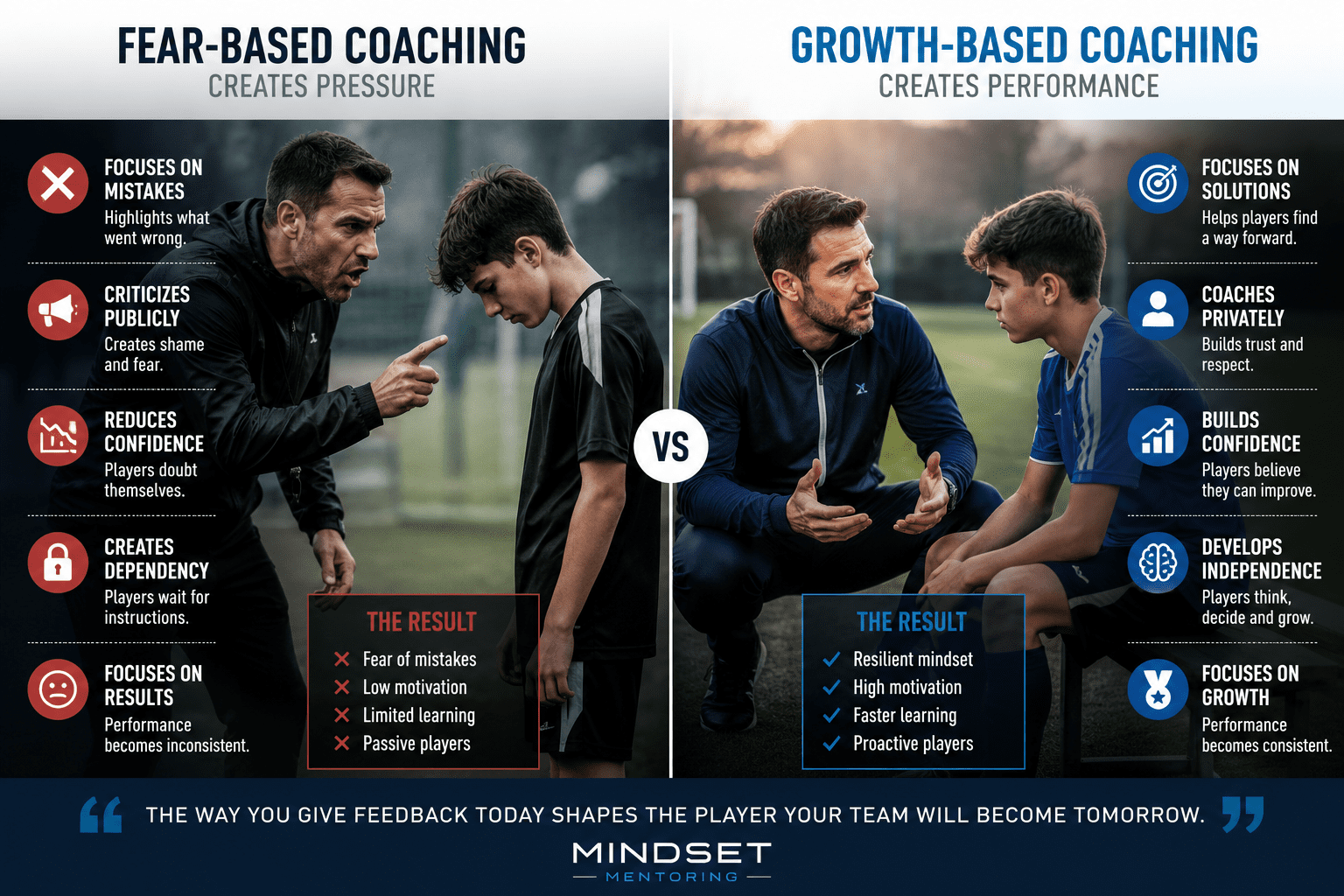
Coach A:
- Shouts
- Criticizes
- Focuses on the error
Coach B:
- Corrects
- Challenges
- Maintains belief
Both coaches saw the same mistake.
The player receives two completely different messages.
And over time, the outcomes can be dramatically different.
Feedback Is Never Neutral
One of the biggest misconceptions in coaching is believing that feedback is simply information.
It isn’t.
Feedback is information wrapped in emotion.
Every time a coach speaks to a player, the player is not only processing the words being said—they are also interpreting the meaning behind them. They are asking themselves questions, often unconsciously:
Does my coach believe in me?
Am I improving?
Am I good enough?
Can I recover from this mistake?
Do I still have the coach’s trust?
This is why two players can receive exactly the same feedback and react completely differently. One player may see it as helpful guidance. Another may see it as criticism or rejection. The difference lies in how the message is interpreted.
For coaches, understanding this reality is crucial.
Every comment has the potential to influence four key areas of performance:
Confidence
Confidence is fragile, especially in young players.
When feedback constantly highlights what is wrong without acknowledging progress or solutions, players may begin to doubt their abilities. Over time, this doubt can lead to hesitation, fear of mistakes, and reduced performance.
On the other hand, effective feedback helps players understand that mistakes are part of development. It reinforces belief while still demanding improvement.
Motivation
Players need reasons to keep investing effort.
Feedback that focuses exclusively on results can make players feel discouraged when things are not going well. Feedback that recognizes commitment, learning, and progress encourages players to stay engaged through difficult periods.
The goal is not to make players comfortable. The goal is to keep them committed to growth.
Attention
What coaches emphasize influences what players focus on.
Imagine a defender who loses possession while trying to play out from the back.
If the coach immediately focuses on the mistake itself, the player may spend the next minutes worrying about making another error.
If the coach instead focuses on the solution—”Next time, scan earlier before receiving”—the player’s attention shifts toward improvement rather than fear.
Great feedback directs attention toward the next action, not the previous mistake.
Learning
Learning happens when players understand what to improve and how to improve it.
Vague comments such as:
“You need to be better.”
rarely create learning.
Specific feedback such as:
“Open your body earlier so you can see both passing options before receiving.”
provides a clear learning opportunity that the player can apply immediately.
The best feedback accelerates learning because it transforms mistakes into information rather than judgment.
Every piece of feedback either strengthens belief or increases doubt. Great coaches understand this responsibility
Antoni Ordinas - Founder of MINDSET Mentoring
The Emotional Memory of Feedback
Here is a reality every coach should remember:
Players do not always remember exactly what coaches said.
They remember how the feedback made them feel.
Years later, many players cannot recall the exact tactical instructions they received from a coach.
What they often remember is whether that coach made them feel:
trusted,
valued,
challenged,
respected,
supported,
or constantly judged.
This emotional memory has a powerful impact on development.
Players who feel safe to make mistakes tend to take more responsibility, show greater creativity, and learn faster. Players who fear mistakes often become cautious, passive, and reluctant to take initiative.
Great coaches understand that feedback is not just about correcting performance.
It is about shaping the environment in which performance develops.
The Three Characteristics of High-Performance Feedback
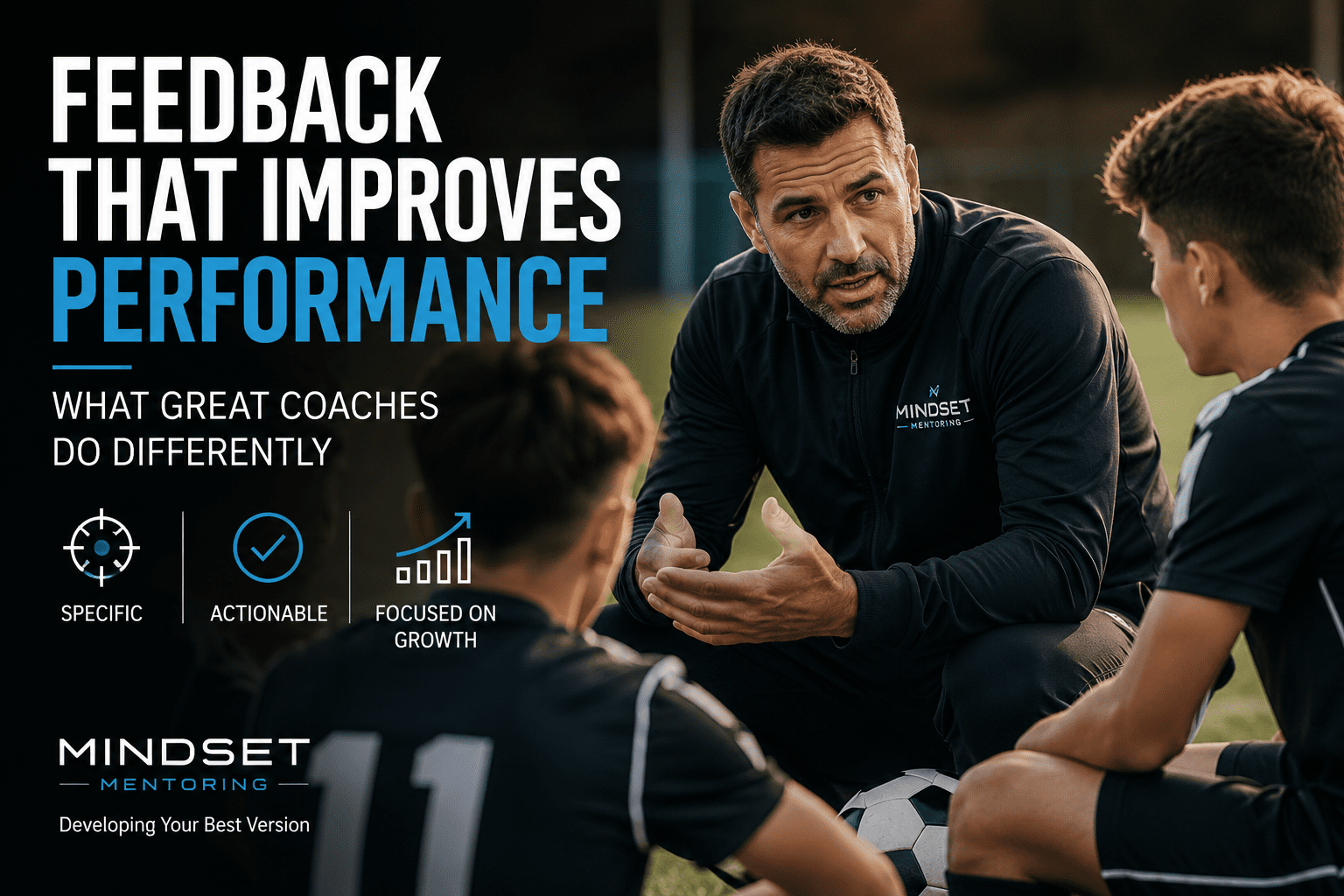
1. Specific
Not:
❌ “You need to do better.”
Instead:
✅ “Scan earlier before receiving the ball.”
2. Actionable
Not:
❌ “Be more confident.”
Instead:
✅ “Communicate earlier and demand the ball.”
3. Focused on Growth
Not:
❌ “You’re not good enough.”
Instead:
✅ “You’re not there yet. Keep working.”
The purpose of feedback is not to judge the player. The purpose of feedback is to improve the next action.
Antoni Ordinas - Founder of MINDSET Mentoring
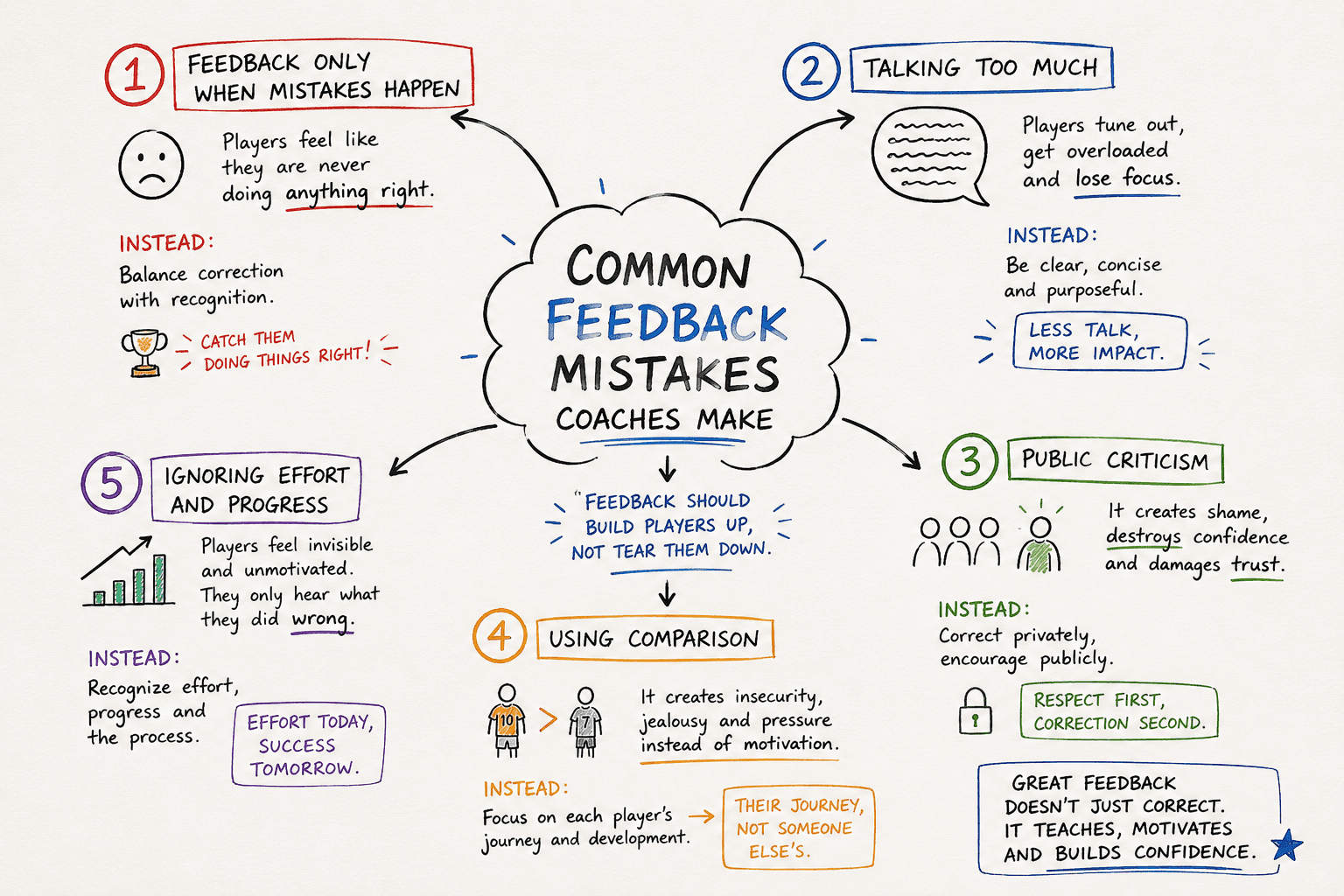
Common Feedback Mistakes Coaches Make
The Best Coaches Build Independent Thinkers
One of the ultimate goals of coaching is often overlooked.
The objective is not simply to create players who follow instructions.
The objective is to develop players who can think, decide, and adapt for themselves.
Soccer is a dynamic game. The ball moves. Opponents adjust. Spaces appear and disappear in seconds. No coach, regardless of experience, can provide solutions for every situation from the sidelines.
Eventually, players must solve problems on their own.
This is why elite soccer is full of moments where players must rely on their own judgment:
A midfielder receives the ball under pressure and must decide where to play next.
A defender recognizes a pressing trigger before teammates do.
A striker identifies a weakness in the opponent’s back line and exploits it.
A goalkeeper adjusts positioning based on the evolving situation.
In these moments, there is no time to look at the coach.
The player’s ability to think independently becomes the difference between reacting and leading.
The Hidden Danger of Over-Coaching
Many coaches genuinely want to help their players.
However, when coaches constantly provide every answer, every correction, and every solution, they can unintentionally create dependence.
Players begin to wait for instructions.
They look to the sideline after mistakes.
They become hesitant to make decisions without approval.
Over time, this can reduce:
❌ Initiative
❌ Creativity
❌ Problem-solving ability
❌ Leadership
The result is a player who performs well when guided but struggles when required to think independently.
Elite environments demand the opposite.
The best players become active participants in their own development.
The ultimate goal of coaching is not to create players who depend on your voice. It is to develop players who can lead themselves. The best coaches teach players how to think, not what to think
Antoni Ordinas - Founder of MINDSET Mentoring
Ownership Creates Growth
The players who improve fastest are usually not the players receiving the most feedback.
They are the players taking the most ownership of their development.
Ownership means:
✅ Reviewing performances honestly
✅ Accepting responsibility
✅ Looking for solutions
✅ Learning from mistakes
✅ Seeking improvement without being told
When coaches create an environment where players feel responsible for their own growth, development accelerates.
The coach becomes a guide rather than a controller.
The player becomes a learner rather than a follower.
Powerful Coaching Questions
Instead of always providing immediate answers, consider using questions such as:
What did you see in that situation?
What options were available?
What influenced your decision?
What worked well?
What would you do differently next time?
What can you control in this moment?
What have you learned from that mistake?
These questions transform feedback from a one-way conversation into a learning process.
They help players build the habits of self-reflection that are essential for long-term success.
Reflection Question
If your players remembered only one thing from your feedback this week, what would it be?